THE REVENGE
Budget Bracket Scenarios & Scalability Plan
A working scenario document for a scalable international geopolitical thriller
Prepared as a separate companion to the Working Production, Packaging & Creative Reference Plan
The same screenplay can support materially different budget versions. The budget range is not one uncertain estimate; it is a set of distinct packaging and execution choices.
Working range under discussion: approximately $10M-$35M, with a lower stress-test floor possible only through aggressive independent packaging and reduced finish standards.
Executive Summary
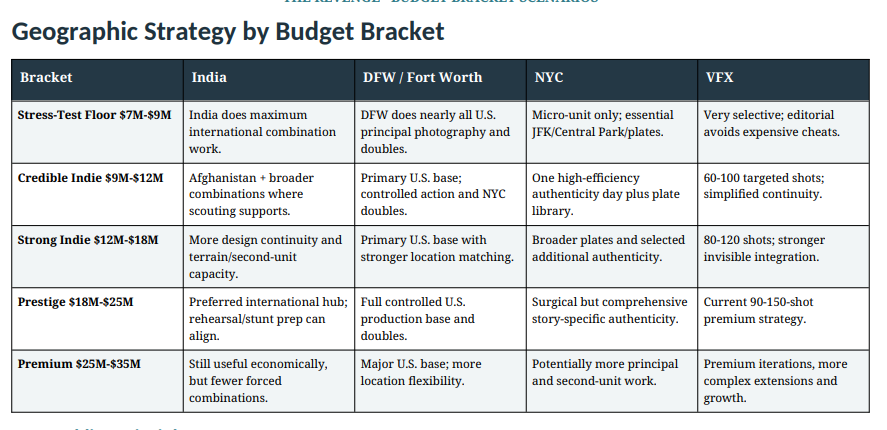
The Revenge is scalable because its apparent international scope can be manufactured through geographic consolidation rather than literal multi-country production. India can provide Afghanistan and other international combinations; Dallas-Fort Worth can provide controlled U.S. principal photography and doubles; New York can be used surgically for authenticity; VFX can unify photographed worlds rather than construct them wholesale.
The lower brackets are achieved primarily by changing above-the-line economics, crew profile, shoot-day discipline and VFX ambition - not by changing the screenplay into a different genre
-
This is the lowest plausible stress-test version.
It assumes the project is deliberately re-engineered around independent above-the-line economics, aggressive geographic consolidation and visibly lower post-production ambition.
Package Assumptions
Independent or emerging Declan and Angar; no expensive star dependency assumed.
Director, DOP and stunt leadership drawn from strong emerging or regional/international talent rather than premium quotes.
Supporting cast built primarily from excellent working actors, local talent and selective short-schedule character players.
Producer and some creative fees may need disciplined structures, deferrals or backend participation.
Production Assumptions
India carries Afghanistan and as much international combination work as practical.
DFW/Fort Worth carries nearly all controllable U.S. dramatic work and doubles.
NYC is limited to a micro-unit for high-leverage authenticity: JFK/Angar arrival elements, Central Park establishment and essential plates.
Tight shooting ratio, fewer company moves, limited nights, minimal crowd complexity and no director-led action expansion.
Ranch assault and kidnapping sequences are designed for coverage efficiency rather than scale inflation.
VFX / Finish
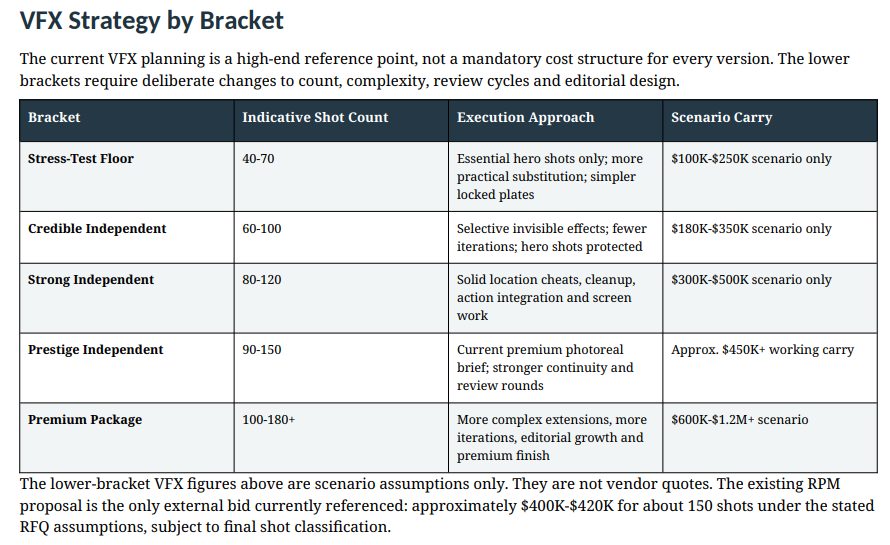
Potentially 40-70 essential shots after editorial redesign and practical substitution.
Reduced iteration count and more selective use of clean plates, locked compositions and simpler 2D/2.5D solutions.
Less aggressive location cheating; shots that cannot be made convincing economically may be reframed, shortened or removed.
Competent independent finish rather than the current premium theatrical RFQ standard
-
This is the first bracket I would regard as a credible lower-cost version of substantially the same movie. It still requires rigorous discipline, but it can preserve the dual-father architecture, international geography, major action beats and a serious ensemble.
Package Assumptions
Emerging or underpriced recognizable leads rather than expensive finance-facing stars across the board.
One meaningful attachment may be retained if the deal is favorable and does not destabilize the physical production budget.
Rising director with strong thriller or festival credentials; capable DOP and stunt coordinator without premiummarket pricing.
Supporting ensemble cast for performance value rather than celebrity value.
Production Assumptions
India + DFW remain the enabling engine; the film avoids literal multi-country principal photography.
NYC remains surgical: story-specific authenticity and plates rather than full conventional unit coverage.
Rehearsal is protected for the central Declan-Angar material, but prep is shorter than the prestige model.
Action is designed around character, geography and tension rather than larger spectacle.
Second unit is selective and tightly integrated with the VFX plan.
VFX / Finish
Approximately 60-100 shots as a working scenario, depending on editorial and practical choices.
Fewer review rounds, simpler environment work and less demanding continuity across every window/background cheat.
High scrutiny reserved for hero shots: drone strike, sniper POV, critical NYC extensions and essential screens.
Streaming-quality credibility is achievable if plate capture and lens/lighting continuity are disciplined.
-
This bracket creates room for a stronger package while preserving the economic advantages of India, DFW and a surgical NYC unit. It is the range where the film can begin to feel deliberately mid-budget rather than constrained.
Package Assumptions
One or two meaningful recognizable actors, with the rest of the ensemble cast for depth and performance quality.
A director with credible feature experience and a stronger visual/action team.
More room for a market-facing Declan or Angar, but not necessarily both at premium quotes.
Selective prestige casting for Alpha or Zeta only if it produces real package value.
Production Assumptions
More rehearsal and stunt preparation for principal actors.
Better schedule protection for the safe-room sequence, ranch assault and kidnapping material.
More production-design continuity across India and Texas doubles.
Stronger second-unit capacity and more resilient contingency for weather, children, travel and action.
NYC plates can be more comprehensive, though principal action remains outside New York.
VFX / Finish
Approximately 80-120 shots as a working scenario.
Stronger invisible-effects continuity and more reliable window/background replacement.
Better action integration, cleanup and environment enhancement.
More post time for sound, DI, mix and final polish.
-
This is the bracket most closely aligned with the current production and packaging thesis discussed for The Revenge. It preserves premium performance ambition, meaningful rehearsal, serious stunt preparation and a higher-confidence invisible-effects finish.
Current Working Package Logic
Angar: Nawazuddin Siddiqui as the current conditional-interest reference, subject to formal deal, schedule and production terms.
Declan: a finance-facing actor in the Chris Pine / Tom Hardy reference space, selected for market value, moral complexity and chemistry with Angar.
Alpha: compressed prestige-veteran strategy, potentially around three principal shooting days.
Zeta: meaningful actress with international visibility and genuine dramatic weight.
Director reference space: David Mackenzie for lived-in human realism; Kathryn Bigelow for operational tension and geopolitical physicality
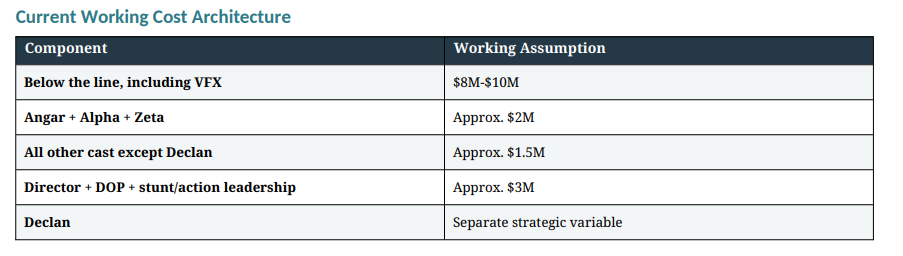
Expense distribution for Prefered Independent production (Texas incentives upto 25% not included)
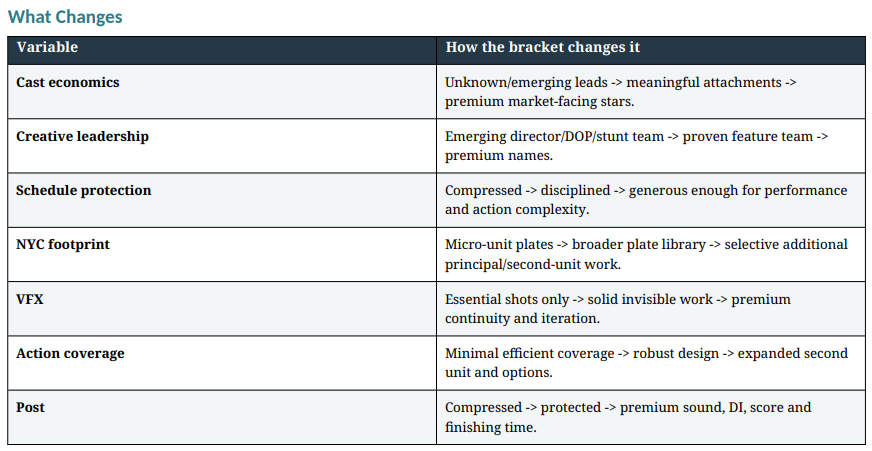
What Changes Across Brackets - and What Should Not
What Should Not Change
The two-father moral architecture: one father acts from revenge, another later chooses whether to repeat the cycle.
Angar as a genuine moral center rather than a generic geopolitical antagonist.
Declan as a full co-lead with guilt, PTSD, fatherhood, action and the burden of receiving mercy.
The first true face-to-face Declan-Angar scene as a major performance sequence.
The lived-in, observational scene language across family, military, FBI and action environments.
The principle that practical human texture comes first and VFX completes geography rather than replacing life.